
‘Monitored Materials’ provides greater confidence when assessing recyclates
- Publicado el 15 de Septiembre de 2026
As part of its newly developed Monitored Materials System, plastship provides data that enables greater transparency and comparability for recycled materials. The regranulate used by Schütz GmbH & Co. KGaA, Selters/Germany, for its Green Layer packaging is the first recycled plastic to be assessed and certified under this system.
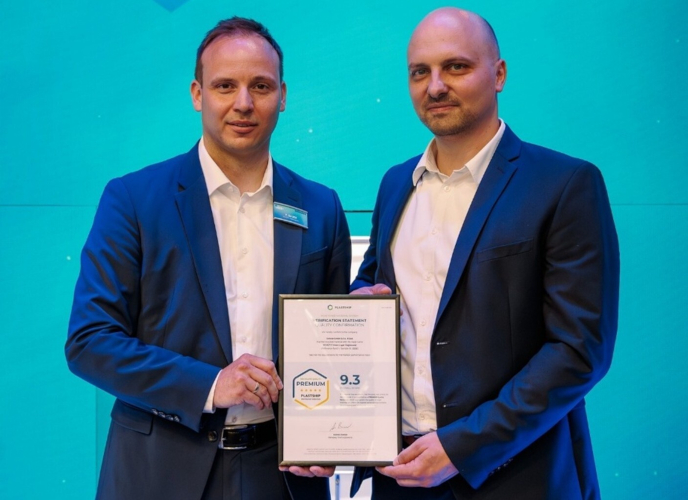
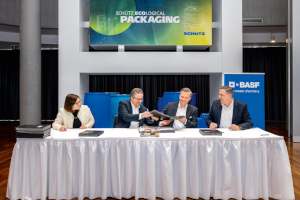
At Interpack 2026, Andreas Bastian, Managing Director of plastship GmbH, presented the corresponding quality certificate to Patrick Bauer, Global Head of SHEQ Management and Technical Customer Service at Schütz GmbH & Co. KGaA, a leading global manufacturer of industrial packaging. The ‘Premium’ rating achieved confirms the high quality of this plastic, processed in-house by Schütz, which is comparable to that of virgin material.
The plastship Monitored Materials system provides a robust data basis for classifying recyclate qualities across companies, comparing them objectively and using them with confidence. It replaces the previously inconsistent structure of individual technical data sheets (TDS) with documents in a standardised, directly comparable format and language. Targeted tests make it possible to transparently map the structural differences between virgin materials and recycled materials, which arise from material streams, processing and applications. The material qualities, made tangible in this way through laboratory data and material flow information, provide greater confidence throughout the entire value chain.
Bastian comments: “With Monitored Materials, we are creating a neutral data basis for the quality of plastic recyclates. It enables the industry to make sound decisions and contributes to a shared understanding of recyclate quality. In this way, it lays the groundwork for an increasing number of high-quality applications for recyclates.”
Recyclate manufacturers can precisely position their products in the market with the help of Monitored Materials. This provides the plastics processing industry with a reliable and rapid basis for decision-making regarding their use. The structured database significantly reduces the time and effort required to search for and qualify new materials, thereby saving time and costs. Material identification in procurement and approval processes is less time-consuming, as validated data sets can be accessed directly. The assessment is carried out transparently using a score from 0 to 10 and classification into one of three quality segments: Premium, Plus or Proven.
The regranulate, which Schütz uses as a central layer in its extrusion blow-moulded Green Layer IBCs, drums and canisters, achieved an outstanding 9.3 points in the assessment under the Monitored Materials System. The corresponding ‘Premium’ classification certifies that the material’s performance and processing properties are comparable to those of virgin material. In the growing database, which comprises 224 materials, it currently ranks in the top 5 per cent of the European market.
In addition to the assessment, customers who have a material tested as a ‘Monitored Material’, as well as holders of an annual subscription, benefit from further advantages. The associated exclusive access to the database serves as a key tool for strategic raw materials management. It enables the creation of dynamic quality rankings, the data-driven comparison of recycled materials against virgin reference materials or the wider market, and the carrying out of direct material comparisons.
Beyond in-depth analyses, such as mapping qualities to specific waste streams, the system also integrates market data on production capacities. This transforms a simple quality overview into a comprehensive management tool for the secure and predictable procurement of recycled materials.
Regulations such as the European Packaging Waste Regulation (PPWR) will further increase the requirements regarding the use of recycled materials and their technical documentation. To provide the industry with a practical solution to this, Monitored Materials form the cornerstone for future compliance evidence. The system is aligned with the EN 18065 standard on institutionalised data quality and transforms recycled material data, which has often been difficult to verify, into reliable quality statements.
The data determined for a Monitored Material is documented in the corresponding verification certificate. This serves as an objective, neutral and validated selling point for recyclers, whilst at the same time providing plastics processors with robust quality confirmation for customers and brand owners. It certifies to both parties that the fulfilment of sustainability targets does not come at the expense of the material’s industrial performance.