
Mono-material packaging simplicity becomes key product benefit as EU regulation deadlines loom, says GlobalData
- Publicado el 23 de Abril de 2026
With legally binding deadlines fast approaching, 2026 marks a watershed for consumer packaging regulation, particularly in the European Union, as the bloc’s Packaging and Packaging Waste Regulation (PPWR) takes full effect in August. As sector priorities are defined by recycling and broader sustainability trends, mono-material packaging solutions will become more important as efforts continue to make packaging more easily recyclable at scale, says GlobalData, a leading intelligence and productivity platform.
Mono-material packaging – based on a single material type, in preference to using several different packaging materials – reduces complications for recyclers and consumers alike. It removes recycling challenges such as separating disparate materials in laminated packaging and simplifies consumers’ waste disposal decisions. As regulatory targets tighten, mono-materials are increasingly becoming a critical innovation focus and a clear pathway to compliance.
Richard Parker, Principal Consumer Analyst at GlobalData, comments: “Regulators around the world are including elements into packaging legislation that promote mono-material solutions, particularly as a function of driving recycling rates and efficiency.”
GlobalData’s latest report “Top Trends in Packaging 2026: Industry Insights,” explores mono-material solutions and reveals the upcoming top trends that are shaping the packaging industry. It provides an overview of major packaging regulation announcements across the world, from the new EU PPWR to state-level regulation updates in the US. Drawing on these developments, the report identifies five emerging trends, namely, mono-materials, smart packaging, biobased packaging, hyper-personalized packaging with AI, and refillables and reusables.
In addition to the EU’s PPWR, California has legislated that all single-use packaging must be recyclable or compostable by 2032, while several other US states’ extended producer responsibility (EPR) regulations create similar impetus to move to mono-material solutions. China’s Single-Use Plastic Control Roadmap reached key milestones in 2025, including the elimination of non-recyclable, multi-material laminates while encouraging polyolefin-based (PP/PE) mono-material solutions, which in effect means "recyclable" is achieved by using mono-material paper or plastic.
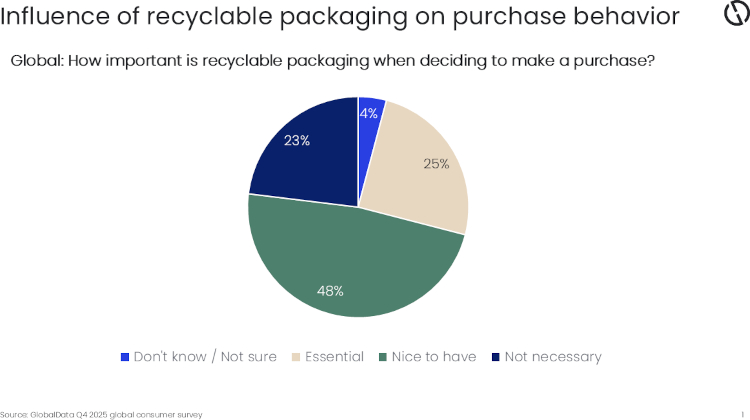
According to GlobalData’s Q4 2025 consumer survey*, a quarter of consumers globally now consider that recyclable packaging is an essential characteristic in the products they buy, and almost half see it as a nice-to-have, showing the extent to which that measure of sustainability and a commitment to environmentally-friendly behavior has penetrated consumers’ routines. Consequently, there is a double incentive for packaging producers to look at mono-material solutions – regulatory pressure and a supportive consumer base looking for quicker, simpler recyclables. Simplicity is a key element in both contexts.
As regulations increasingly penalize hard-to-recycle formats, mono-material packaging helps brands improve recyclability scores, reduce EPR fees, and simplify compliance reporting. Regulation is also targeting the wastage associated with oversized packaging, which increases space used in transportation and storage while wasting it inside the packaging. Simple, mono-material, and correctly sized packaging helps to evade regulatory pressure, while also appealing to consumers, who are increasingly critical of the space and recycling challenges that they can face when dealing with oversized packaging.
The challenge for packaging producers adopting mono-material approaches is to deliver performance comparable to the multi-material packaging they are seeking to replace. Traditional packaging works because it leverages the complementary properties of multiple materials to solve problems such as securing product longevity, hygiene, and packaging durability. Relying on one material to achieve the same can be difficult, necessitating continued materials research and acceptance of the limitations of and unsuitability of mono-materials in some cases.
Parker concludes: “For brands, mono-materials are no longer a niche innovation but a baseline expectation for future packaging strategies. To remain competitive and compliant, brands should prioritize redesigning packaging portfolios around mono-material solutions, invest in material and barrier innovation to maintain product performance, and ensure packaging choices align with local recycling infrastructure and evolving sustainability regulations.”